Nippori to Sendagi: The Old-Town Walk Your Map App Skips
Two stations less than two kilometres apart, in the part of Tokyo that the fires missed. Your map app will send you down the fast road. The lanes it skips hold a cemetery avenue, a postwar shopping street and a tunnel of shrine gates.
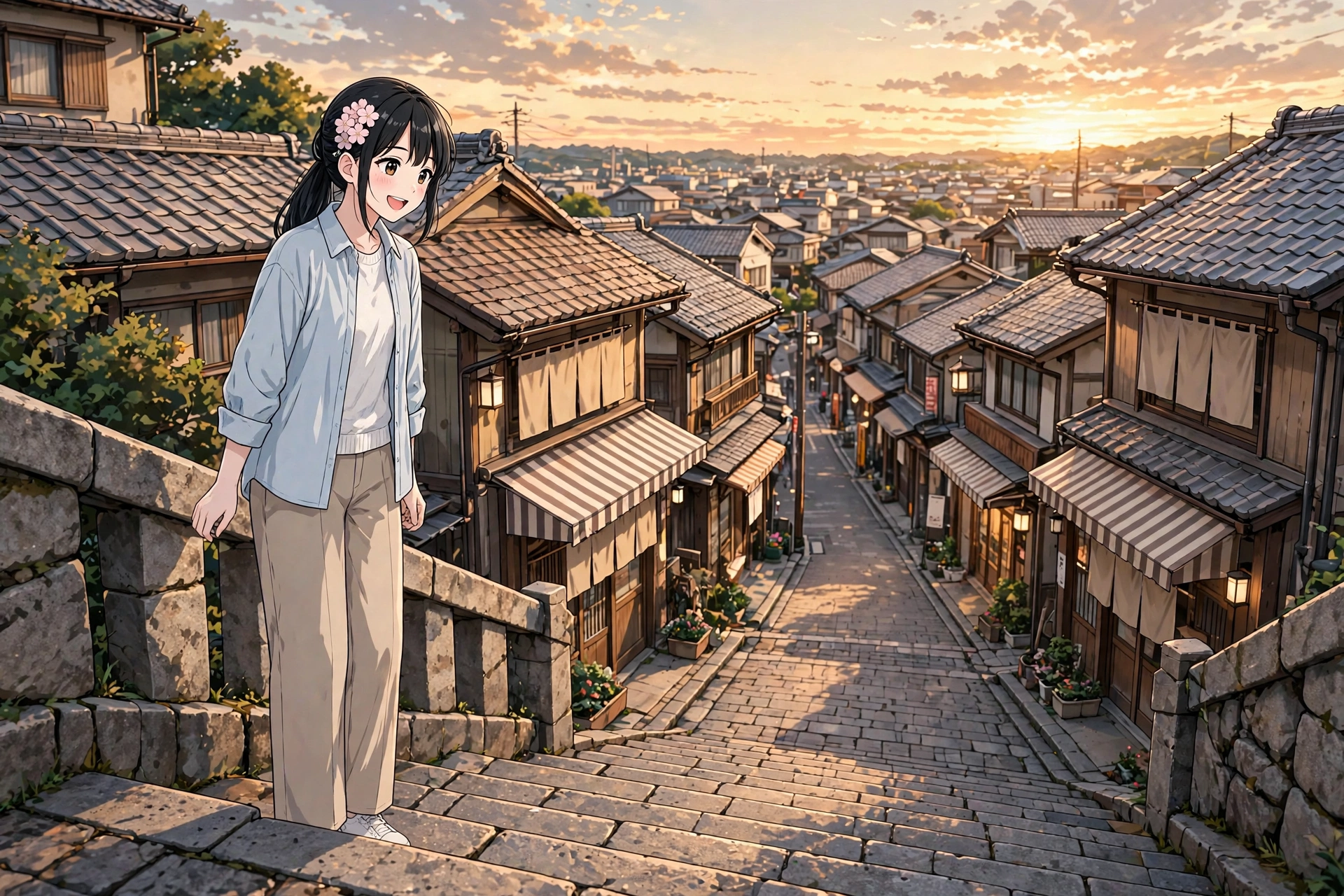
Nippori and Sendagi face each other across Yanesen — Yanaka, Nezu and Sendagi — the old-town district that kept its prewar street plan through both the 1923 earthquake and the wartime air raids. The streets here are lanes, not avenues; the shops are family-sized; cats sit on the roofs.
The direct walk between the stations takes about twenty minutes and shows you almost none of it. This walk takes the long way on purpose: along a fabric district's edge, across a cemetery avenue, down a shopping street built for the neighbourhood, and through a tunnel of shrine gates — the same two stations, a completely different Tokyo.
The short version
Two stations, two Tokyos. The default route is a direct main-road walk, ≈1.4 km and ≈20 minutes. The curated route takes the long way: the edge of Nippori's fabric district, where ≈90 cloth shops line one street → under the tracks to Kannonji's roofed mud wall → Yanaka Cemetery, a cherry avenue among ≈7,000 graves, past the last shogun's resting place → Yanaka Ginza, a 170-metre postwar shopping street reached by the 36 sunset steps of Yuyake Dandan → the back lanes to Kayaba Coffee, a 1916 townhouse café → Nezu Shrine, its 1706 buildings and tunnel of donated torii → Sendagi Station. Snacks: a butcher's menchi-katsu, cat-tail doughnuts, an egg sandwich, a taiyaki if you're early. Toilets: three free anchors — both stations and the cemetery. Best start: late morning.
Open the default route in Google Maps Open the curated old-town route in Google Maps
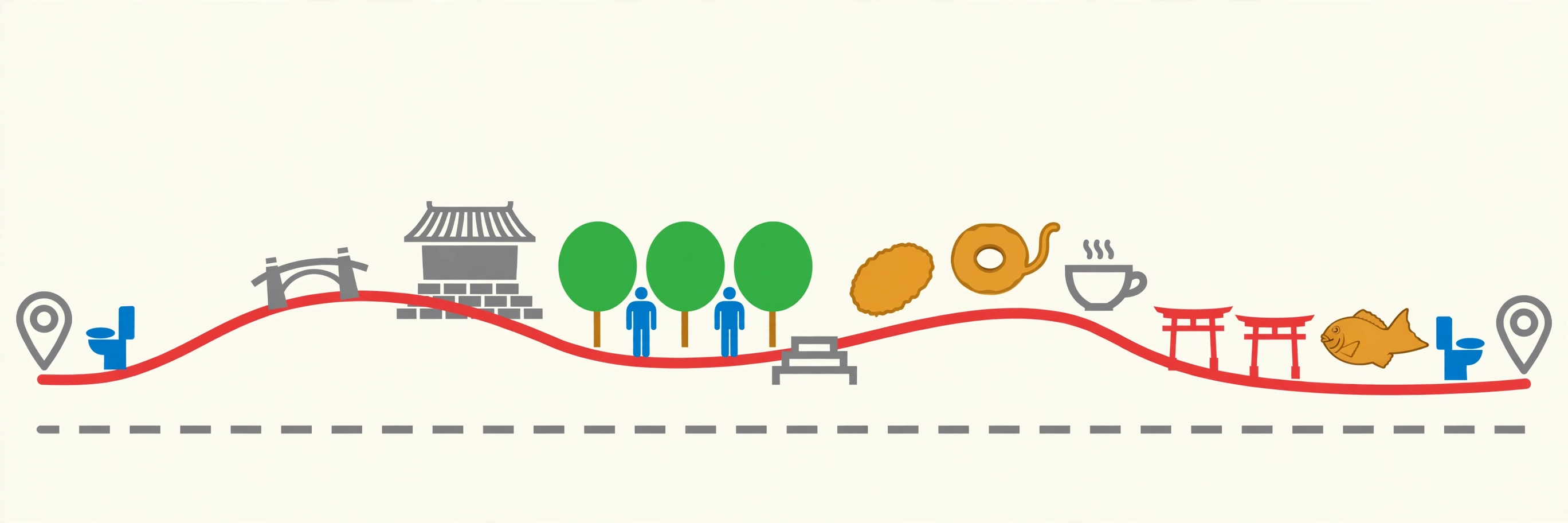
The default route — what your map app gives you
From Nippori, standard navigation runs you south on the district's main roads — an estimated ≈1.4 km and ≈20 minutes of continuous walking (the live link below shows the current figures).
It is an efficient walk, and an honest one — these are real neighbourhood streets. But it stays on the roads the lanes feed into, and so it passes the cemetery, the shopping street and the shrine without entering any of them. The old town is five minutes to either side the whole way, and invisible.
Open the default route in Google Maps
Under the tracks, along the fabric streets
Leave Nippori Station by the east exit and the walk starts in cloth. This side of the station is Nippori Fabric Town (Senigai): roughly 90 fabric and notions shops along about a kilometre of Nippori Chuo-dori — a wholesale district that sells to anyone who walks in. The curated walk only grazes its edge (many shops close on Sundays); it is a five-minute overture, not the destination.
The useful waymark comes a few minutes on: the Shimogoinden Bridge, where the lanes pass under the railway. Locals call it the "Train Museum" — from the bridge, trains of several lines pass at close range, and on a clear day Mt Fuji is visible in the distance. Cross under the tracks here and the fast road is behind you.
Open the curated old-town route in Google Maps The full walk in this article, waypointed via Yanaka Cemetery, Yanaka Ginza and Nezu Shrine.
Beyond the bridge, the lanes lead to Kannonji Temple — and you come for its wall. The tsujibei is a 37.6-metre wall of layered mud and flat tiles, capped with roof tiles, surviving from the late Edo period and registered as a Tangible Cultural Property. In a district of wooden houses and narrow lanes, it is the walk's first piece of old Tokyo that you can touch.
The cemetery avenue: Sakura-dori
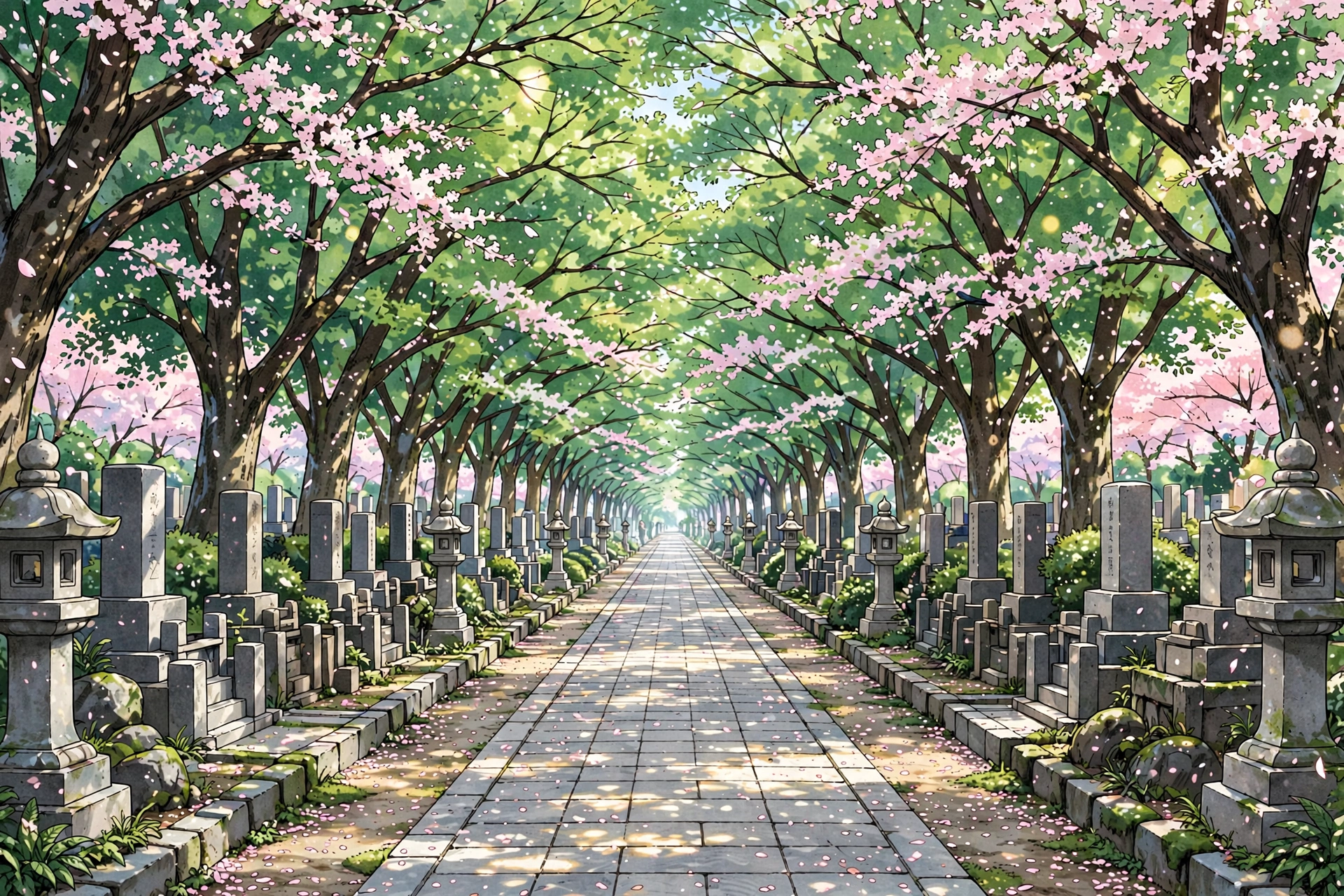
Yanaka Cemetery opened on 1 September 1874, on land that had belonged to the temples Tennoji and Kan'eiji. It covers about 10 hectares and holds roughly 7,000 graves — and its central avenue, Sakura-dori, is lined with cherry trees. In late March and early April it becomes one of the city's calmest places to see the blossom; this is a working cemetery, so the custom is a quiet walk, not a picnic party under the trees.
The cemetery's most visited grave belongs to Tokugawa Yoshinobu, the fifteenth and final shogun, who rests in the Kan'eiji section — the English map at the administration office marks it. Nearby, by Sakura-dori, the foundation stones of Tennoji's five-storey pagoda still sit in the grass: the pagoda burned in 1957, in a double-suicide fire, and was never rebuilt. Its silhouette survives in literature — Koda Rohan modelled his novel The Five-Storied Pagoda on it.
Tennoji itself, Yanaka's oldest temple (founded in 1274), stands at the cemetery's edge. Its bronze Daibutsu — a seated Shaka Nyorai cast in 1690 — is a designated cultural property. In the Edo period the temple was famous for something livelier: its grounds hosted one of the city's three great lotteries (tomikuji), until the shogunate ended them in 1842.
— The Guide: Edo came here to gamble — this temple ran one of the city's great lotteries.
Down the sunset steps: Yanaka Ginza
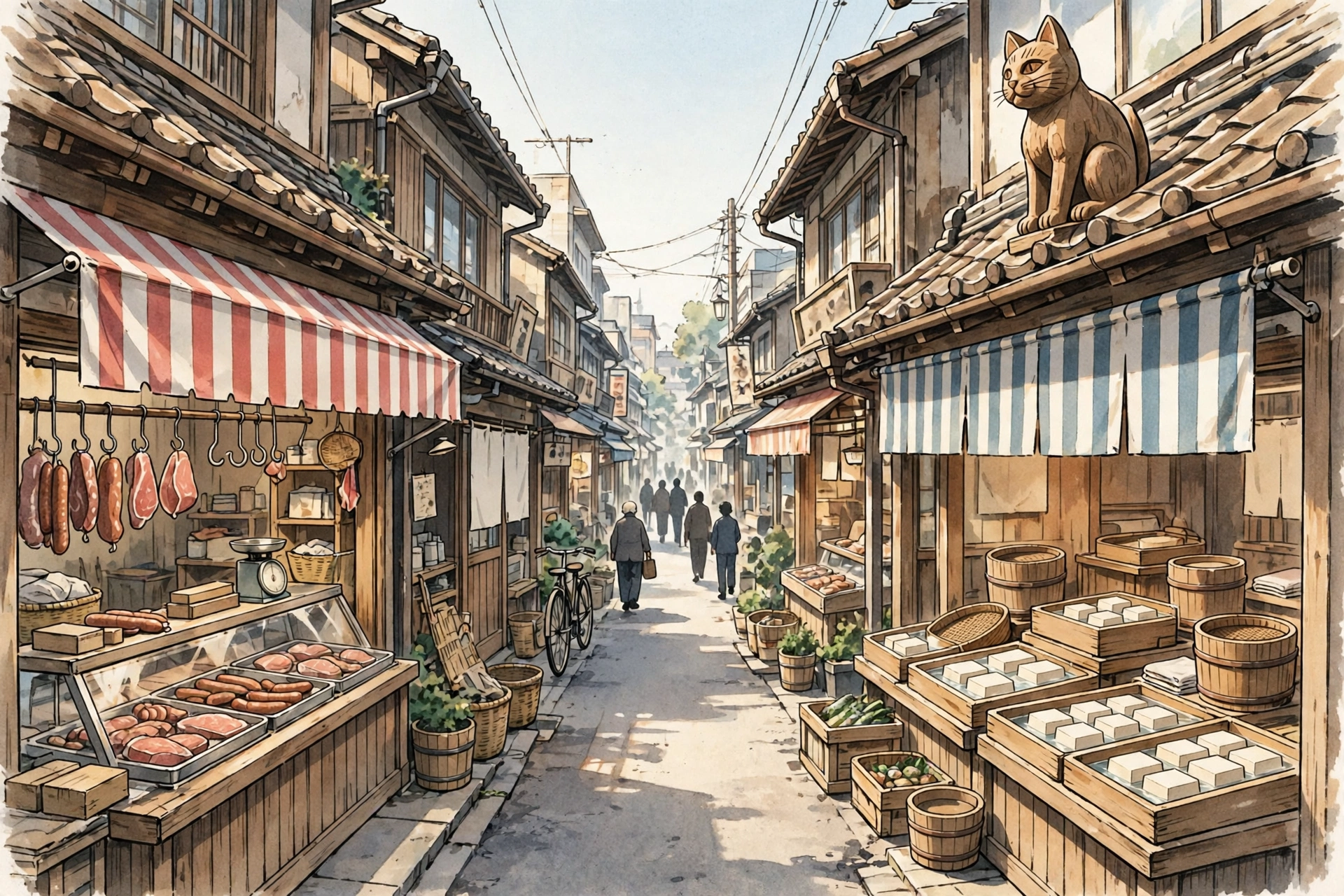
From the cemetery, the lanes run gently downhill to Yomise-dori and the walk's centrepiece: Yanaka Ginza, about 170 metres of shopping street with roughly 60–70 family-run shops. The street grew up around 1945 as the neighbourhood's own — greengrocers, tofu makers, a florist, delicatessens — and it still serves the people who live here first and visitors second. Most shops open around 10:00 and close around 18:00 or 19:00, each on its own schedule; several food shops close on Mondays.
You enter down the Yuyake Dandan — "Sunset Steps" — a 36-step staircase facing west, so the evening light pours straight down the street below. It is the district's emblematic view, and the reason a late-afternoon finish times itself. Seven carved wooden cats, placed by the shopping-street association, wait on the street's signs and rooftops: finding them is the street's quiet game.

Detours & comfort
The Guide's snack stops — and, further down, the route's toilet anchors. The small certainties that make a long walk easy.
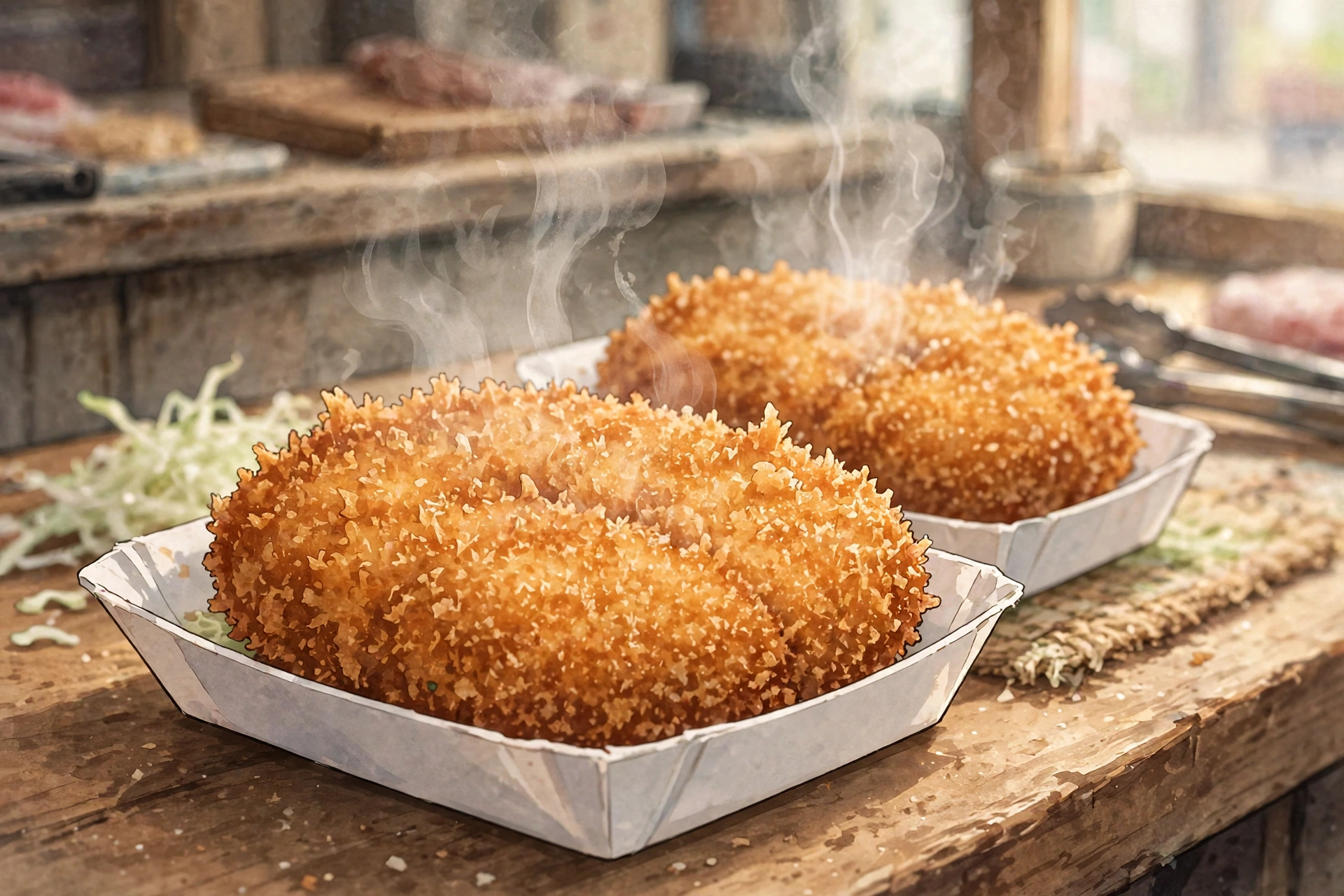
Niku no Suzuki — the menchi-katsu anchor
On the street since 1933, a wagyu butcher that grew a handmade deli counter. The signature is the Genki Menchi Katsu — an all-beef minced cutlet, fried to order, sold from the counter for a few hundred yen: crisp, juicy, strictly walk-and-eat food. It can mean a wait at busy times. Hours 10:30–18:00; closed Mondays and Tuesdays. The shop asks customers to eat beside the shopfront and step aside with their rubbish — this is still somebody's neighbourhood street.
Illustration: the treat itself — freshly fried menchi-katsu — created for this site (no licence-clean photograph of the treat was available).
Yanaka Shippoya — doughnuts shaped like cats' tails
A few doors along, this bakery makes baked doughnuts in the shape of a cat's tail — 13 or 14 flavours on a given day, the chocolate-striped "Tora" (tiger cat) the best seller. Hours 10:00–18:00 (to 19:00 on weekends and holidays); closed days are irregular.
No photo here, on purpose: the real things are long cat-tail sticks, and the stock photo we first ran showed round ring doughnuts — the wrong shape entirely. We took it down rather than show you the wrong thing; an official photo is being sought.
The back lanes and a 1916 coffee house
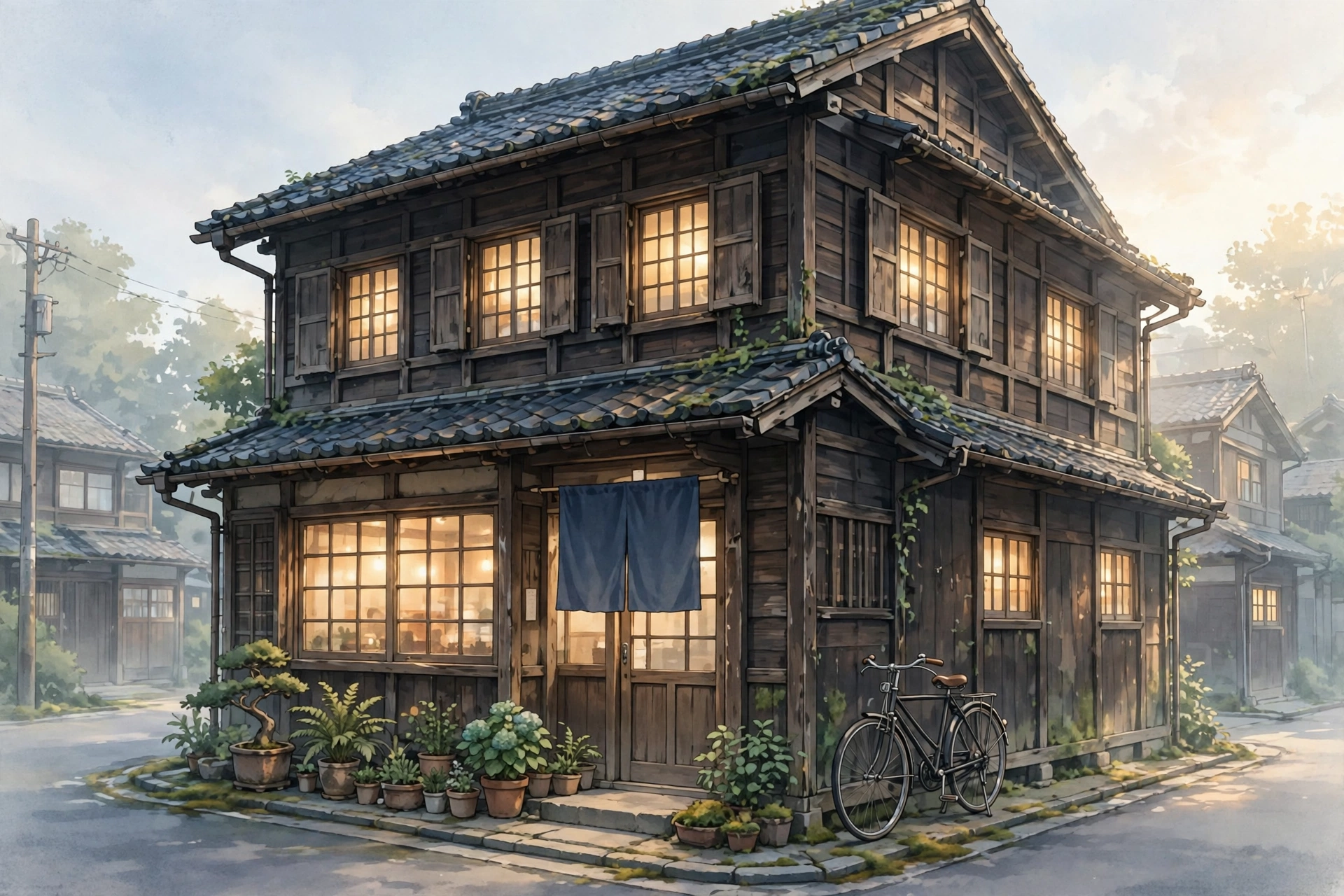
Past the shopping street, the route gives up on straight lines. The lanes between Yanaka Ginza and Nezu — temple walls, old houses, the odd cat asleep on a gatepost — are the district's connective tissue, and the walk's quietest stretch.
On Kototoi-dori's corner stands Kayaba Coffee: a wooden townhouse built in 1916 that has been a coffee house since 1938. It closed in 2006 and was revived in 2009 by local volunteers and an NPO — a neighbourhood rescue that worked. It opens at 08:00 (closed Mondays) and is known for its tamago sando, the Japanese egg sandwich. This is the walk's sit-down pause: proper coffee, a wooden interior, and time to watch the lanes go by.
Kayaba Coffee — the sit-down pause
A coffee house since 1938 in a townhouse built in 1916, closed in 2006 and revived in 2009 by local volunteers and an NPO. Known for its tamago sando (egg sandwich). Opens 08:00; closed Mondays. Order, sit, and let the back lanes slow you down — that is what the stop is for.
Nezu Shrine and the tunnel of gates

The lanes deliver you to Nezu Shrine, which tradition dates back some 1,900 years. What you see is younger and, for Tokyo, rarer: the present shrine buildings were completed in 1706 under the fifth shogun, Tokugawa Tsunayoshi, and they survive complete — seven structures designated national Important Cultural Properties, in the gongen-zukuri style. The shrine's own guide notes that its romon gate is the only one of its kind left at a shrine in old Edo.
On the slope below the main hall, the senbon torii run in a vermilion tunnel down to the Otome Inari shrine — hundreds of donated gates, duck-through height, light striping the path. Above them, the azalea hillside carries about 3,000 bushes in some 100 varieties; each April the Bunkyo Azalea Festival fills the slope with colour (in 2026 it ran 1–30 April, the garden open 9:00–17:30, entry by a donation of ¥500–1,000 on the shrine's published terms; the grounds themselves are free outside the festival garden). Five minutes beyond the gates is Nezu Station — but the walk has one more stop, a small one.
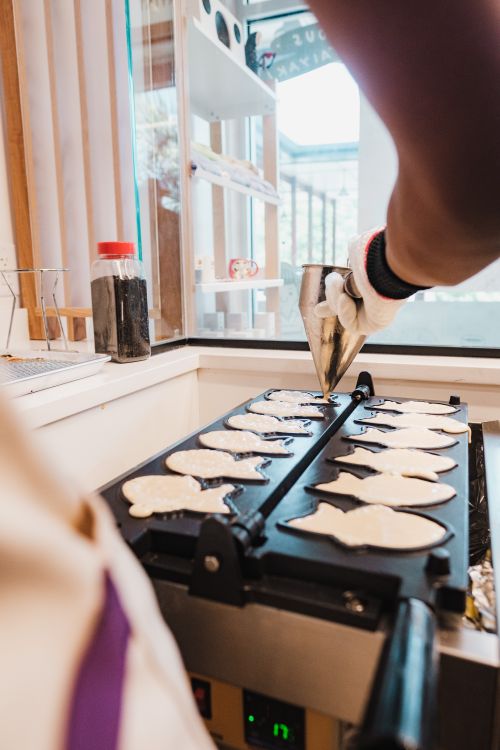
Nezu no Taiyaki — one item, baked one by one
A few minutes from the shrine, on the way to Sendagi Station, this stall has sold exactly one thing since 1957: a taiyaki — the crisp, fish-shaped pastry with sweet red-bean filling — baked one at a time in the iron mould, takeaway only. It opens around 10:00–10:30 and closes when the day's batch sells out, usually by early afternoon; opening days vary, so weekday mornings are the best chance. If the shutter is up, the walk ends with something warm in your hand.
Photo: the treat — taiyaki being made — not the shop's own product. Photo: Airam Dato-on via Pexels.
The two walks, side by side
| Feature | Default Main-Road Route | Curated Old-Town Route |
|---|---|---|
| Primary scenery | Main-road frontage, traffic | Fabric streets, cemetery avenue, postwar shopping street, shrine and torii tunnel |
| Walking distance (estimate) | ≈1.4 km | ≈3.0 km |
| Pure walking time (estimate) | ≈20 min | ≈50 min |
| Total budgeted time (estimate) | ≈20 min | 2–3 hours with stops |
| Terrain & Access | Flat, paved sidewalk | Paved lanes and gentle slopes; one 36-step staircase (a slope beside it) |
The honest trade: about thirty extra minutes of walking buys you the fullest hour in old Tokyo — a cemetery avenue, a shopping street that still feeds its neighbours, and a shrine whose 1706 buildings survived everything the century did to the city around them — ending at its quietest station.
Practical planning
- Best time of day: Start late morning. The shopping street wakes around 10:00, the taiyaki stall sells out by early afternoon, and the cemetery avenue is at its best in soft light. If you can, finish on the Yuyake Dandan steps toward sunset — the street is named for it. Nezu Shrine's azalea garden is an April event; the cemetery cherries peak late March to early April.
- Terrain & luggage: Mostly paved lanes with gentle slopes; the one pinch is Yuyake Dandan's 36 steps (the street continues on a slope beside them, and the metropolitan accessibility guide maps step-free variants of this course). Wheel the big cases and the walk becomes a haul — travel hands-free.
- Navigation: The lanes fork without much signage, and the quiet stretch between the shopping street and the shrine is exactly where a map pin earns its keep. Side streets near the cemetery are narrow with passing cars — walk single file where the locals do.
- Route links (Google Maps, walking mode): Default route Curated old-town route The distances and times in this article are estimates; opening either link shows the live walking distance and time in Google Maps.
Toilets on this route
Start: JR Nippori Station (station restrooms, including accessible) · Midpoint: Yanaka Cemetery, by the former pagoda site (wheelchair-accessible restrooms, 8:30–17:00) · Destination: Sendagi Station (station restrooms, including accessible). All free. Use the cemetery block while it is open — it closes at 17:00, after which the two stations carry the route; no leg of the walk runs more than about 30 minutes between anchors.
Using a Japanese toilet: the bidet seat's three buttons are おしり (oshiri — rear wash) · ビデ (bidet — front) · 止 (stop). Toilet paper is provided, and it is flushable.
Carry a small hand towel — many restrooms have no paper towels, and locals carry their own. A tenugui hand towel doubles as a souvenir.
Plan this trip
- Read our complete guide to luggage in Japan — the 160 cm rule, forwarding and lockers before you set out — this is a hands-free walk.
- Stay connected while navigating the back lanes with our Japan eSIM comparison.
- Browse the old town's take-home side in our guide to buying souvenirs in Japan by where you live.
Sources
- Tokyo Metropolitan Government — Tokyo Sightseeing Accessibility Guide, course 13 "Yanaka, Nezu, Sendagi" — the accessible version of this course: segment distances and times, the Shimogoinden Bridge viewpoint, the Kannonji wall, the cemetery restrooms and hours (course page updated 31 March 2026; information current January 2023; accessed 7 November 2026).
- Tokyo Metropolitan Park Association & GO TOKYO — Yanaka Cemetery: opened 1874, area, grave count, Sakura-dori, the Tokugawa Yoshinobu grave and the pagoda site; restroom facilities (accessed 7 November 2026).
- Nezu Shrine (official site) — 1706 buildings and cultural-property status, senbon torii and Otome Inari, azalea planting; Bunkyo Azalea Festival 2026 dates, garden hours and donation on the shrine's published terms (accessed 7 November 2026).
- Yanaka Ginza Shopping Street Association directory & reference cross-checks — street length and shop count, Yuyake Dandan (36 steps, west-facing), the seven wooden cats; Tennoji (founded 1274; bronze Daibutsu cast 1690; tomikuji lotteries); Kannonji tsujibei (37.6 m, Registered Tangible Cultural Property); Nippori Fabric Town (association figures: ≈90 shops, ≈1 km); Nippori Station lines and access times (accessed 7 November 2026).
- Google Maps — Directions links for both routes on this page, built with the Google Maps URL API in walking mode (added 7 November 2026); opening a link shows the live distance and time for that route.
- Walker-comfort sources (checked 7 November 2026) — Yanaka Ginza Shopping Street Association shop directory (Niku no Suzuki, Yanaka Shippoya: hours and closing days); Kayaba Coffee coverage by the Yanaka community and listings (1916 house, 1938 opening, 2009 revival, 08:00 opening, Monday closing); Nezu no Taiyaki listings and the shop's own posts (one item, sold-out closing). Shop prices are deliberately not quoted — they appear only on each shop's own current menu.
Advertising disclosure. This page contains affiliate links — advertising. If you buy through a link on this site, we may earn a commission, at no extra cost to you. Prices and conditions shown here were checked against the providers' official pages on the dates stated and may have changed since. This site is a research desk: everything here is compiled from publicly available information, not from personal use, and nothing on this page is a personal endorsement based on first-hand experience.