JR Pass Break-Even: The Arithmetic, Route by Route
One Tokyo–Kyoto round trip no longer pays for the pass. Here is the maths, route by route, from published JR fares — so you can run the same test on your own itinerary.
Advertising disclosure. This page contains affiliate links — advertising. If you buy through a link on this site, we may earn a commission, at no extra cost to you. Prices and conditions shown here were checked against the providers' official pages on the dates stated and may have changed since. This site is a research desk: everything here is compiled from publicly available information, not from personal use, and nothing on this page is a personal endorsement based on first-hand experience.
The short answer
A 7-day pass (¥50,000 on the official site) beats individual tickets only when your long-distance legs inside the window add up to more than the pass price.
Tokyo–Kyoto return alone is ¥27,700 in tickets — the pass loses. Add Hiroshima, Kyushu, or stack regions on a 14–21 day trip, and the pass wins.
Current pass prices
The JR Group sells the pass at two price levels. Buying on the official JAPAN RAIL PASS site is cheaper than buying an Exchange Order through an overseas agency (agency prices rose on 1 October 2026).
| Pass | 7 days | 14 days | 21 days |
|---|---|---|---|
| Ordinary — official site | ¥50,000 | ¥80,000 | ¥100,000 |
| Ordinary — overseas agency | ¥53,000 | ¥84,000 | ¥105,000 |
| Green Car — official site | ¥70,000 | ¥110,000 | ¥140,000 |
| Green Car — overseas agency | ¥74,000 | ¥116,000 | ¥147,000 |
Children aged 6–11 pay half. The pass is sold only to visitors entering Japan on "Temporary Visitor" status, and it is no longer sold at stations inside Japan.
Source: JAPAN RAIL PASS official site, "Types and prices" — https://japanrailpass.net/en/purchase/price/ (accessed 7 Nov 2026).
Buy the Japan Rail Pass — official online sales
Ad — this card contains an affiliate link. See our disclosure.
What the pass covers — and the one big exception
The pass covers reserved and non-reserved seats on JR trains across all six JR companies, including every train on the Tohoku, Hokkaido and Hokuriku Shinkansen, plus the Tokyo Monorail and the JR West Miyajima ferry (the island's ¥100 visitor tax is still payable). Seat reservations are free with the pass.
The exception: Nozomi (Tokaido/Sanyo) and Mizuho (Sanyo/Kyushu) — the fastest services on the Tokyo–Osaka–Fukuoka corridor — are not covered. Pass holders can ride them only by buying a separate "[ONLY WITH JAPAN RAIL PASS] NOZOMI MIZUHO Ticket" for each ride. The supplement costs the same whether you sit in a Green Car, a reserved Ordinary seat, or a non-reserved seat:
| Section | Supplement (one way) |
|---|---|
| Tokyo – Nagoya | ¥4,180 |
| Tokyo – Kyoto | ¥4,960 |
| Tokyo – Shin-Osaka | ¥4,960 |
| Tokyo – Hiroshima | ¥6,500 |
| Shin-Osaka – Hakata (Fukuoka) | ¥4,960 |
Source: JAPAN RAIL PASS official site, NOZOMI MIZUHO Ticket price list (accessed 7 Nov 2026).
Everything in the break-even tests below therefore uses Hikari, Sakura, Kodama, Hayabusa and Kagayaki services — the fastest trains the pass covers without a supplement.
The fare yardsticks
Individual ticket prices used in this guide are the published regular-season totals for one adult, one way, in a reserved Ordinary-car seat (basic fare + reserved-seat limited express charge). Reserved-seat charges move with JR's seasonal calendar — roughly ¥200 less in off-peak periods and ¥200–400 more in peak periods (Golden Week, Obon, New Year) — so treat these as regular-season benchmarks, not quotes.
| Route (pass-covered train) | One-way reserved fare |
|---|---|
| Tokyo – Nagoya (Hikari) | ¥11,090 |
| Tokyo – Kyoto (Hikari) | ¥13,850 |
| Tokyo – Shin-Osaka (Hikari) | ¥14,400 |
| Tokyo – Hiroshima (Hikari) | ¥18,910 |
| Tokyo – Hakata, Fukuoka (Hikari routing) | ¥22,750 |
| Kyoto – Hiroshima (Hikari/Sakura) | ¥11,300 |
| Shin-Osaka – Hiroshima (Sakura/Hikari) | ¥10,420 |
| Hiroshima – Hakata (Sakura/Hikari) | ¥9,100 |
| Tokyo – Kanazawa (Kagayaki) | ¥14,600 |
| Tokyo – Sendai (Hayabusa) | ¥11,630 |
| Tokyo – Shin-Hakodate-Hokuto (Hayabusa) | ¥24,200 |
Sources: Tokaido/Sanyo fares from JR West's official fare handbook "Kippu no Rule" (October 2026 edition), cross-checked 26–29 Oct 2026; Tohoku/Hokuriku fares reflect JR East's base-fare revision of 14 March 2026 — https://www.jreast.co.jp/en/2026unchin-kaitei/ (accessed 7 Nov 2026).
Worked example 1: Tokyo–Kyoto round trip only
The most common plan: fly into Tokyo, take the shinkansen to Kyoto, come back.
- Tokyo → Kyoto (Hikari, reserved): ¥13,850
- Kyoto → Tokyo (Hikari, reserved): ¥13,850
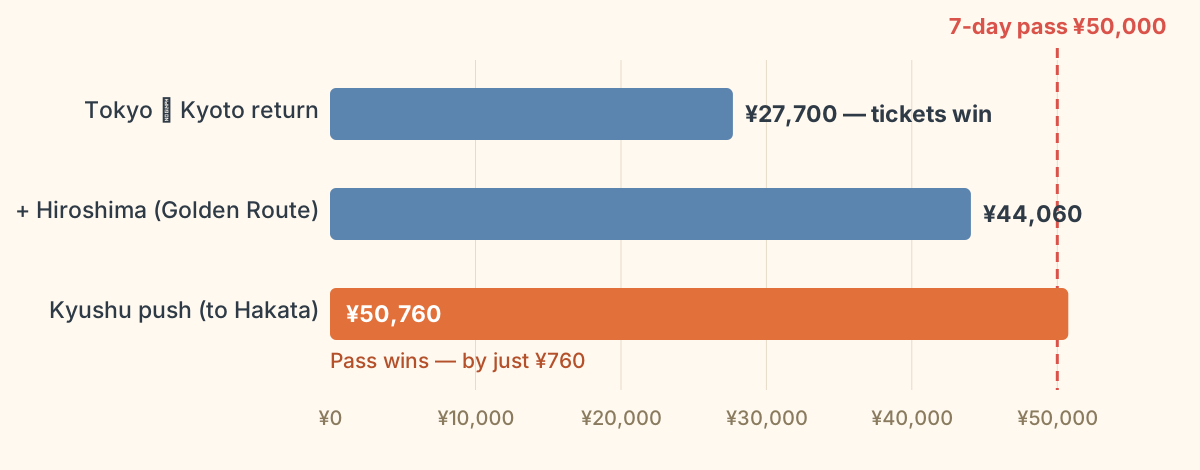
- Individual tickets total: ¥27,700
- 7-day Ordinary pass: ¥50,000
Verdict: individual tickets win by ¥22,300. A pass bought for this trip alone wastes money, even before considering that the pass also puts you on the slower Hikari instead of the Nozomi.
Worked example 2: the "Golden Route" with Hiroshima (7 days)
Tokyo → Kyoto → Hiroshima → back to Tokyo, inside one week.
- Tokyo → Kyoto: ¥13,850
- Kyoto → Hiroshima: ¥11,300
- Hiroshima → Tokyo: ¥18,910
- Individual tickets total: ¥44,060
- 7-day Ordinary pass: ¥50,000
Verdict: individual tickets still win, by ¥5,940. Even the classic three-city route no longer breaks even. The pass flips into profit only if you add roughly one more long leg inside the same 7 days — for example, a Tokyo–Nagoya round trip (¥11,090 × 2 = ¥22,180) would take the ticket total to ¥66,240, making the pass the cheaper option by ¥16,240.
Worked example 3: pushing west to Kyushu (7 days)
Tokyo → Hiroshima → Hakata (Fukuoka) → Tokyo.
- Tokyo → Hiroshima: ¥18,910
- Hiroshima → Hakata: ¥9,100
- Hakata → Tokyo: ¥22,750
- Individual tickets total: ¥50,760
- 7-day Ordinary pass: ¥50,000
Verdict: the pass wins — by just ¥760. Break-even is a knife edge on western itineraries. One fewer leg, one shorter hop, or off-peak ticket pricing, and the advantage disappears. Note also the time cost: pass-covered trains on this corridor (Hikari/Sakura with a change) are slower than the direct Nozomi, which the pass does not cover.
Worked example 4: the grand tour (14–21 days)
A three-week loop taking in Hokkaido, Kanazawa and the Golden Route:
- Tokyo → Shin-Hakodate-Hokuto: ¥24,200
- Shin-Hakodate-Hokuto → Tokyo: ¥24,200
- Tokyo → Kanazawa: ¥14,600
- Kanazawa → Tokyo: ¥14,600
- Tokyo → Kyoto: ¥13,850
- Kyoto → Hiroshima: ¥11,300
- Hiroshima → Tokyo: ¥18,910
- Individual tickets total: ¥121,660
- 21-day Ordinary pass: ¥100,000 → pass wins by ¥21,660
- (If the same legs fit inside 14 days: 14-day pass ¥80,000 → pass wins by ¥41,660)
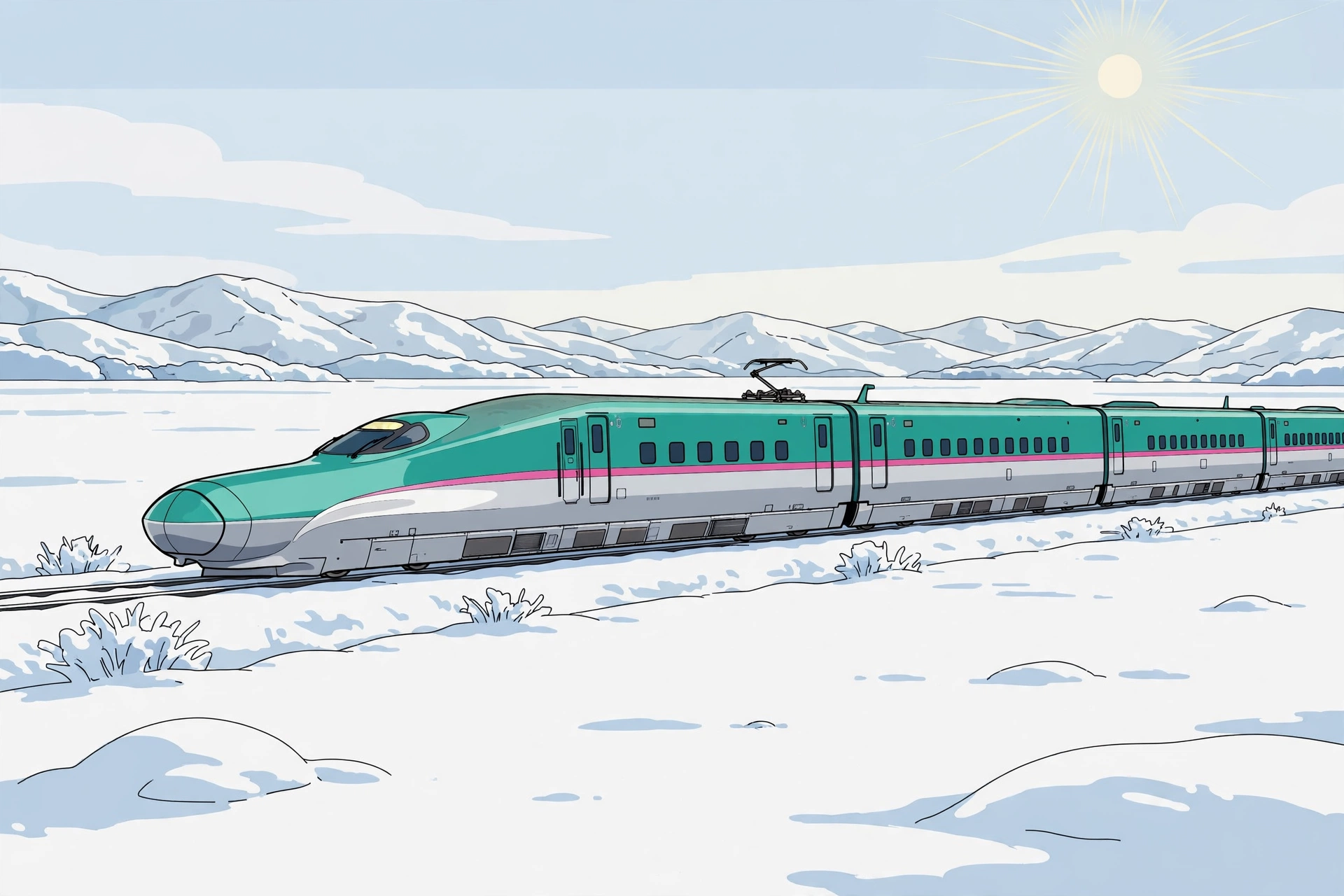
Verdict: the pass is built for this traveller — long distances, multiple regions, legs stacked tightly together.
Which to pick, by trip type
Run three checks, in order:
- Add up your long-distance legs at the fares in the table above (local city travel barely moves the total — a day of city trains is typically a few hundred yen). If the sum is below the pass price, buy individual tickets. Full stop.
- Check the daily burn rate. The pass must "earn" ¥7,143/day (7-day), ¥5,714/day (14-day) or ¥4,762/day (21-day) in fares. One Tokyo–Kyoto-class leg (¥13,850) covers about two days of a 7-day pass; sightseeing days with no long train ride earn nothing.
- Count the Nozomi penalty. If your route is the Tokyo–Osaka corridor and you care about speed, price both options honestly: pass + supplements (¥4,960 per Nozomi ride on Tokyo–Kyoto/Shin-Osaka) versus plain Nozomi tickets (Tokyo–Kyoto reserved ¥14,170). Riding Hikari instead costs roughly 20–30 minutes per leg against the Nozomi — decide what your time is worth before, not after, buying.
Buy the pass if: your itinerary stacks long legs (Kyushu, Hokkaido, or three-plus regions) tightly inside the validity window, or you value hop-on flexibility for unplanned day trips by shinkansen.
Buy individual tickets if: you are based in one or two cities, making one return trip, or travelling slowly with rest days. Also consider regional passes (JR East, JR West and others sell area passes that can undercut both options on a single-region trip) — a comparison of regional passes is planned as a follow-up article on this site.
Rules and gotchas
- The pass runs on consecutive calendar days from the start date you choose — rest days inside the window are paid for whether you ride or not.
- Seat reservations are free but not automatic: reserve at a ticket machine or office, or — for passes bought on the official site — online before you collect the pass.
- Riding Nozomi/Mizuho without the supplement ticket is the expensive mistake: the full fare adjustment falls due. When in doubt, ride Hikari or Sakura.
- A big suitcase changes which seat to reserve — see the luggage guide linked below.
FAQ
Is the JR Pass worth it for Tokyo and Kyoto only? No. A Tokyo–Kyoto round trip costs ¥27,700 in reserved Hikari tickets against ¥50,000 for a 7-day pass (checked November 2026). Buy individual tickets.
Can I ride the Nozomi with a JR Pass? Only with the separate NOZOMI MIZUHO Ticket bought for each ride — ¥4,960 for Tokyo–Kyoto or Tokyo–Shin-Osaka, the same price for Green, reserved or non-reserved seats.
Is it cheaper to buy on the official site or through an agent? The official site. Since 1 October 2026, overseas-agency Exchange Orders cost more (7-day Ordinary ¥53,000 vs ¥50,000 online).
Does the pass cover city transport? It covers JR lines in cities (such as Tokyo's Yamanote loop) and the Tokyo Monorail, but not subways or private railways. City travel is cheap either way and rarely changes the break-even result.
Before you ride
Two practical companions to this guide:
- Enjoying the Shinkansen: Mt Fuji seats, ekiben and the art of the ride — which side of the train faces Mt Fuji, and how to pick seats.
- Luggage in Japan: the 160 cm rule, forwarding and lockers — if your suitcase totals more than 160 cm, you must reserve a seat with an oversized baggage area on the Tokaido, Sanyo and Kyushu Shinkansen.
- Staying connected on the train starts at the airport: see our Japan eSIM comparison for data options before you land.
Sources and verification
- JAPAN RAIL PASS official site — types and prices; NOZOMI MIZUHO Ticket prices. https://japanrailpass.net/en/purchase/price/ (accessed 7 Nov 2026)
- JR West, "Kippu no Rule" fare handbook, October 2026 edition (Tokaido/Sanyo fare tables).
- JR East — 2026 fare revision (base fares revised 14 Mar 2026; express charges unchanged). https://www.jreast.co.jp/en/2026unchin-kaitei/ (accessed 7 Nov 2026)
- Seasonal variation of reserved-seat charges: JR Central seasonal calendar, as summarised in fare guides checked Oct 2026 (secondary cross-check).
Note on figures: all fares are regular-season, adult, one-way, reserved Ordinary-car totals including tax. JR has announced further changes to some Nozomi/Mizuho and Green Car charges taking effect in 2027 — check the official sites before buying.
Advertising disclosure. This page contains affiliate links — advertising. If you buy through a link on this site, we may earn a commission, at no extra cost to you. Prices and conditions shown here were checked against the providers' official pages on the dates stated and may have changed since. This site is a research desk: everything here is compiled from publicly available information, not from personal use, and nothing on this page is a personal endorsement based on first-hand experience.
Keep dreaming: the same trains, ridden purely for the view — Scenic rail journeys in Japan.